

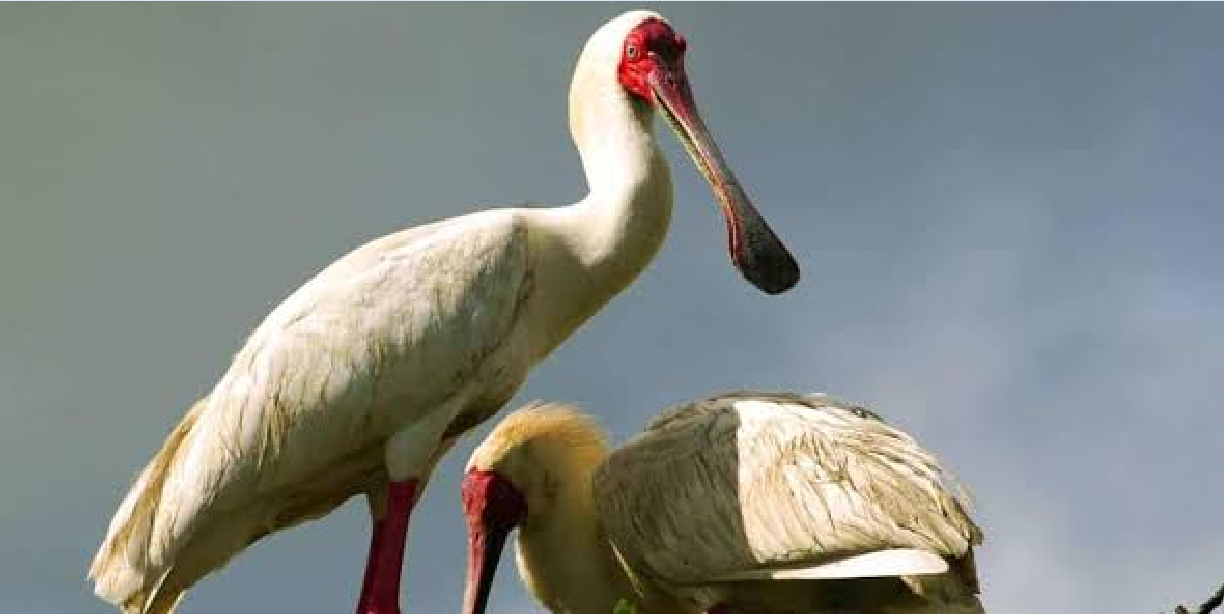
Fascinating Facts about the African Spoonbill
The African Spoonbill’s spoon-shaped bill draws the interest of many birdwatchers and nature enthusiasts, who wonder why it has this kind of bill. You will gain a better grasp of its spoon-shaped bill by reading this article. The distinctive bill of this wading bird makes it stand out from other birds associated with water.
Their bill is completely distinct from other birds’ because, as the name implies, it is shaped like a spoon. The African Spoonbill is a wading bird that can travel through water in search of food thanks to its long legs and white or pale pink plumage, depending on the area.
Their unusual bill actually makes sense and appears to be quite useful to many individuals, particularly those who enjoy the outdoors and birdwatching. Compared to the typical pointed bill, this unusual spoonbill appears to be considerably simpler to use. Its bill clacks, particularly when it’s feeding.
Feeding
They often feed smaller animals and aquatic living things like fish, insects, larvae, and shellfish, among others, and are not very discriminating when scooping. Their bill’s spoon-shaped portion is so sensitive that it can sense even the tiny live things they eat, such fish and invertebrates.
The spoon-shaped bill also has a large number of mechanoreceptors for tactile feeding. According to hydrodynamics studies, the spoon tip can create vortices that raise small fish and invertebrates off the bottom, improving the likelihood that they would be caught.
With its recognizable spoon-shaped bill, which is ideal for scooping food and makes perfect sense in the wild, they are adept at making people grin. Because of this, nature is incredibly beautiful, full of exquisite nuances and flawless adaptations.
Habitats
They favour environments close to water sources, such as riverine areas, marshes, water channels, river banks, and lake coasts, because they are water-related birds. In Africa, they can be found in places like the northern Zulu land areas near the Hlihluwr River in South Africa, the Limpopo River, the River Okavango, and the Kazinga Channel in Queen Elizabeth National Park.
Outside of Africa, they can be found in Florida, the eastern part of the United States, and South Carolina along Edisto Beach, particularly with the Roseate Spoonbill species (Platalea ajaja) and Zeeland, though they are sporadically observed.
Compared to other tiny waders, they are larger and more robust, yet they are still difficult to spot because they can reach a height of 90 cm, or roughly 35.4 inches. Although the male and female share a similar appearance, they do not have this spoon-shaped bill from birth. Rather, they have a small beak at birth that eventually grows into a spoon-shaped bill. By the time they emerge from the nest, the shape resembles a spoon.
Breeding
In colonies, they typically reproduce from late March to September. In April and May, the females lay three to five eggs. For almost 29 days, both parents incubate these eggs. Due to their shyness and secrecy, spoonbills typically travel alone, making it extremely uncommon to witness a mating colony.
On a fortunate day, you may be able to see this amazing bird species with its gorgeous spoon-shaped bill. They even hang around when they are distant from people and safari vehicles.